The Lovers Tarot: meaning of Major Arcana VI and the crossroads of individuation
February 22, 2026

Claire Duval
I am an author of tarot decks, oracles, Petit Lenormand, and passionate about cartomancy. I share my work and passion with you.
Latest articles
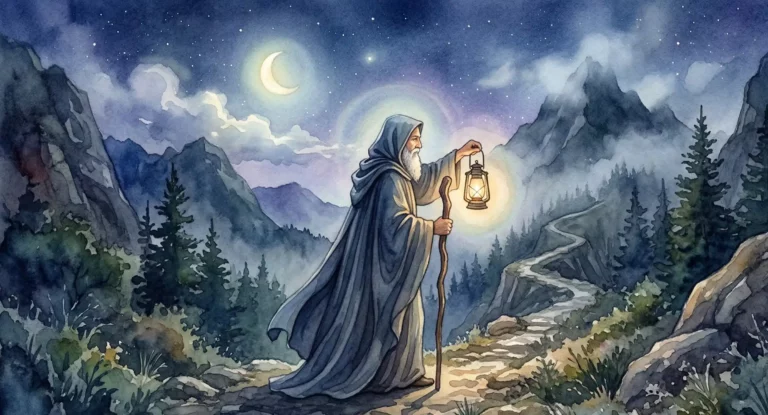


We all go through a phase of disorientation when the landmarks inherited from those around us are no longer enough to guide us. Arcana VI marks this passage: the birth of one’s own will, the moment we stop defining our life by what we should do and begin exploring who we want to be.
Within the architecture of the tarot, Arcana VI comes after a long formative period under external influences. The Fool, embodiment of vital energy, has grown under the influence of the Empress (the mother, nature), the Emperor (the father, social law), and the Hierophant (dogma, morality). But after being shaped by these authority figures, the individual arrives at a crucial crossroads. Arcana VI: the great crossroads of individuation.
1. Introduction: breaking free from others’ expectations
Up to this point, the Fool has grown under the influence of structuring external forces: the Empress (the mother, nature), the Emperor (the father, social law), and the Hierophant (dogma, morality). But after being shaped by these authority figures, the individual arrives at a crucial turning point.
Arcana VI is, in the truest sense, the birth of one’s own will. It is the moment when we stop defining our life by what we ought to do and begin exploring who we want to be.
2. The shift from obedience to individuation
The Lovers represents a fundamental psychological rupture: the shift from a life governed by conformity to a life guided by inner alignment. It is no longer society or family speaking through us — it is the “Self” emerging from the fog of collective expectations.
The core challenge of this card is contained in this visceral question. This is not selfish whimsy, but the recognition of one’s own desire. The Lovers challenges us to choose our commitments — whether romantic, professional, or existential — according to our own truth.
3. From “The Lover” to “The Lovers”: a shift in perspective
The history of this card reveals a fascinating semantic shift that transforms our understanding of choice.
Titled “L’Amoureux” in the singular, the card focuses on the individual’s dilemma. We see a young man standing between two women, often interpreted as virtue and vice. Above them, a cherub draws his bow, yet a crucial detail remains: we do not yet know toward whom he will release his arrow. This uncertainty embodies the anguish of choice, that moment of suspension before commitment.
In the 20th century, the card often becomes “The Lovers.” The emphasis shifts from individual choice toward relational harmony. Yet this move from singular to plural carries a risk: it may cause us to forget that to form a harmonious “we,” one must first have successfully completed the stage of individuation represented by the Tarot de Marseille.
Iconic variations
The imagery highlights both Lancelot’s choice of courtly love — respect for the Lady and transcendence of self — and, at a deeper level, the union of the masculine and the feminine within oneself.
The Deviant Moon Tarot uses black and white to evoke a complementarity close to Yin and Yang, where one cannot reach wholeness without the other.
4. The Lovers at work: the question of alignment
Drawing The Lovers in a professional context is rarely the sign of an office romance. It is a warning signal or validation regarding the nature of your relationship with your career.
What kind of professional relationship do you find yourself in today? Are you merely executing tasks, or are you genuinely emotionally invested in your projects? The Lovers reminds us that without pleasure and alignment with our values, action loses its meaning and its force.
Are your current professional choices driven by social conformity, or by your authentic desire for expression?
5. The secret link between The Lovers and The Devil: consciousness vs. impulse
Numerological tarology reveals a striking mirror between The Lovers (6) and The Devil (15, because 1+5=6). This connection illuminates the internal struggle between our conscious values and our unconscious mechanisms.
The Lovers seeks the deliberate choice and the impulse of the heart. Choosing a partner out of genuine love, acting in alignment with one’s own values, charting one’s path with intention.
The Devil represents the suffered impulse, addiction, or submission to shadow patterns. It is the repetition of an unresolved trauma that governs our choices without our awareness.
6. Ambiguity as strength: learning to navigate uncertainty
The Lovers is one of the most complex arcana because it offers no ready-made answer: it acts as a mirror of our uncertainties. Its richness lies in the multiplicity of interpretations accumulated over the centuries.
It forces us into introspection: what is the quality of my connections? Why am I in this relationship? The card does not tell us what to do — it compels us to look squarely at the complexity of our emotional life and the responsibility we carry in each of our choices.
The ambiguity of The Lovers is not a weakness in the card — it is precisely what makes it such a powerful tool for introspection. It does not answer: it questions.
7. Conclusion: the choice is yours
The Lovers is, at its core, the card of reclaimed freedom. It marks the end of blind obedience and the beginning of personal responsibility. This choice — sometimes painful — is nonetheless the indispensable fuel for the journey ahead: after Arcana VI comes Arcana VII, the Chariot, which represents action and achievement. But one can only drive one’s own chariot once one has first chosen one’s destination.
Look at your life today — your relationships, your work: are you acting from genuine desire, or from mere habit, following rules you never chose?
Join my community
Receive my exclusive readings, my cartomancy teachings, and my guidance to accompany you on your path. Join 30,000 souls seeking light.